Living in Uptown, Charlotte NC (2026)
Charlotte's dense, high-rise core where Trade & Tryon, two stadiums, and four historic wards meet at the city's original crossroads.
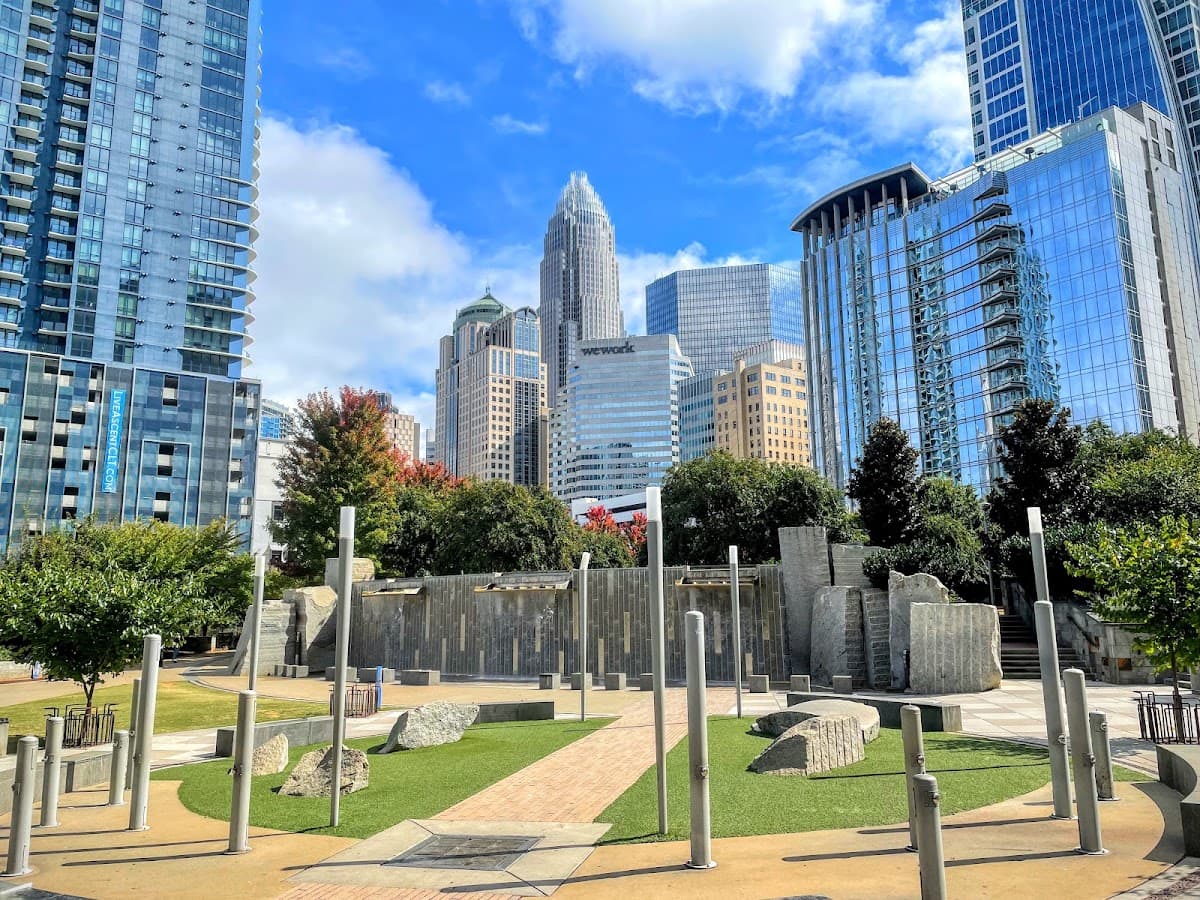
Romare Bearden Park
About the area
Uptown is Charlotte's original town, laid out around the crossing of Trade and Tryon streets that residents still call The Square, marked by four sculptures nicknamed for transportation, industry, commerce, and the future. From here the city splits into four wards: First Ward's rebuilt townhomes and greenway to the east, Second Ward to the south (once home to Brooklyn, Charlotte's largest Black neighborhood before 1960s urban renewal cleared it for government buildings), Third Ward's mill-era streets beside Bank of America Stadium, and Fourth Ward's restored Victorian cottages to the north.
High-rises define the skyline: Bank of America Corporate Center, Duke Energy Center, and the Truist towers, stacked above Spectrum Center. West of the towers, Romare Bearden Park, named for the Charlotte-born collage artist, gives Third Ward a green anchor next to the stadium and the LYNX Blue Line.
Quick facts
Neighborhood vs Charlotte citywide. Walkability is rated Green / Orange / Red from its percentile among Charlotte planning areas.
| Metric | This area | Charlotte citywide |
|---|---|---|
| Median home sales price | $427,573 | $489,824 |
| Median household income | $98,542 | $98,184 |
| Median age | 32.2 | 36.4 |
| Population | 19,176 | 1,154,681 |
| Walkability (EPA) | 16.2Strong | 10.4Typical |
Demographics
Figures come from the U.S. Census Bureau's American Community Survey (ACS) 5-year estimates for Uptown vs Charlotte citywide. ACS is an ongoing Census survey; the 5-year product pools recent responses so smaller neighborhoods have more stable estimates than a single year.
| Metric | This area | Charlotte citywide |
|---|---|---|
| Median household income | $98,542 | $98,184 |
| Median age | 32.2 | 36.4 |
| Population | 19,176 | 1,154,681 |
| Owner-occupied | 31.2% | 57.2% |
Amenities
City of Charlotte proximity scores, EPA walkability, and city crime rates for Uptown vs Charlotte citywide. Each figure is rated Green / Orange / Red from its percentile among Charlotte planning areas (configurable in admin). Crime rates are reported-incident indicators, not a safe/unsafe verdict. Read how to read Charlotte crime rates and methodology.
- Grocery proximity
- 56.3Typical
Charlotte 37.5Typical
- Transit proximity
- 100Typical
Charlotte 74.4Typical
- Tree canopy
- 10.7Typical
Charlotte 46.7Typical
- Walkability
- 16.2Strong
Charlotte 10.4Typical
- Violent crime rate
- 11.7Weak
Charlotte 4.4Typical
- Property crime rate
- 106.4Weak
Charlotte 32.9Typical
City of Charlotte
City of Charlotte
City of Charlotte
EPA
City of Charlotte
City of Charlotte
Reading the data
Home sales indicators for Uptown come from Charlotte's Quality of Life Explorer, population-weighted across the planning areas in our Uptown crosswalk, not an MLS median or appraisal. That figure lands at $551,581, well above the $474,833 citywide rollup, consistent with an inventory dominated by high-rise condos and new-build apartments rather than single-family resales. Household income follows the same pattern: $105,545 here against $94,896 citywide, reflecting the concentration of finance and professional-services workers who live near where they work.
Walkability is the clearest signal that Uptown behaves differently from the rest of Charlotte. Its EPA index of 15.5 sits in the most-walkable band, more than four points above the citywide average of 10.6. Compare that to South End, which trades some of Uptown's density for lower prices and a similar transit-first score, or to Fourth Ward, whose brownstone blocks post a walkability score closer to Uptown's despite a much smaller population.
Population estimates put roughly 34,388 residents in the Uptown crosswalk, with a median age of 32.0, a decade younger than many surrounding neighborhoods.
Relocation notes
Uptown living means condo or apartment living almost without exception; there is very little standalone housing stock inside the four wards, aside from a pocket of restored homes in Fourth Ward. Buyers and renters here choose a high-rise or mid-rise unit, often with a parking deck stall included, trading square footage for a walk to work, a stadium, or Romare Bearden Park. The Blue Line runs the length of Uptown, making a car optional for trips to South End, NoDa, or university-area park-and-rides.
Before committing, tour buildings on both sides of the wards. First Ward and Third Ward skew newer with amenity-heavy towers; Fourth Ward offers a quieter, historic feel. Confirm parking is included rather than a separate lease, since street parking is scarce and metered.
Data limitations
These figures describe Uptown as a union of Charlotte's official planning areas, not a marketing boundary drawn by a broker. Home sales indicators reflect statistical rollups, not MLS medians or individual listings, and can smooth over real differences between a First Ward tower and a Fourth Ward brownstone. ACS estimates carry margins of error at this geography. Treat every number here as directional context, not a substitute for touring buildings yourself.
Research Uptown by goal
Match lifestyle, budget, or hazard questions to Charlotte-wide guides, then return to this profile for local tables and map deep links.
Nearby schools
Charlotte-Mecklenburg Schools (CMS) campuses near Uptown. Exact assignment depends on your address. Verify with the CMS school locator and NC DPI report cards for ratings. We list names and levels only.
Elementary
- First Ward Creative Arts0.4 mi
- Irwin Academic Center0.8 mi
- Walter G. Byers0.9 mi
Middle
- Piedmont1.0 mi
High
- Central Piedmont Early College1.1 mi
- Hawthorne Academy Of Health Science1.4 mi
- Hawthorne Military And Global Leadership1.4 mi
FAQ
What is the median home price in Uptown, Charlotte NC?
According to City of Charlotte home sales data as of 2023, Uptown has a median home sales price of about $427,573, compared with roughly $489,824 Charlotte citywide. Figures are city sales indicators, not an MLS median.
What is the median household income in Uptown?
U.S. Census Bureau American Community Survey (ACS) 5-year estimates for Uptown show a median household income of about $98,542 (ACS 2024) (Charlotte citywide ≈ $98,184). Small-area ACS estimates have sampling error; treat as directional.
How walkable is Uptown?
For Uptown, the EPA National Walkability Index is 16.2 on a 1–20 scale (Green: Strong among Charlotte planning areas), EPA vintage 2021. Walkability: Green (Strong) vs Charlotte NPAs — higher scores rank better. Open the walkability layer on the map for spatial context.
Is Uptown a good place to live in Charlotte?
Fit depends on budget, commute, and priorities. Uptown’s median sales price ($427,573) compares to the Charlotte citywide figure ($489,824). Use Know Charlotte to compare demographics, walkability, and adjacent neighborhoods; we report public data, not buy/sell advice.
Where is Uptown on the Charlotte map?
Open the interactive Charlotte neighborhood map and jump to this area via the explore link on this page. Map selection uses planning area 182; see methodology for how named neighborhoods relate to official planning boundaries.
Nearby & similar
Nearby neighborhoods
Shared or touching neighborhood boundaries
Explore on the interactive map
Sources: Data sources · Methodology. Page reviewed 2026-09-05.